

Construction projects run on documents. Lien waivers, contractor affidavits, change orders, and permit applications all need notarization. A single delay in notarization stops the payment cycle. Subcontractors wait. General contractors hold retainage. Developers miss deadlines.
Scalable remote online notarization fixes this. A secure online notary service connects signers with a commissioned notary through video. The process takes minutes, not days. But construction firms need more than basic notarization. They need high‑volume workflow automation, AI‑powered document processing, and tamper‑evident seals for every affidavit.
This article reviews seven platforms. The focus is on construction and development use cases: lien waivers, contractor affidavits, and project documentation.
The Construction Project Lifecycle – Where Notarization Slows You Down
A construction project moves through five phases. Each phase has documents that need notarization. Each notarization can become a bottleneck.
Phase 1: Pre‑construction (Permits and Contracts)
Building permit applications and prime contracts require notarized signatures. Notary delays on permit applications add days, preventing groundbreaking until a valid seal is affixed. Errors in the notary seal necessitate reapplication.
Phase 2: Construction (Progress Payments and Lien Waivers)
General contractors face significant delays in releasing progress payments because monthly lien waivers from subcontractors require correct, notarized seals to be enforceable. Processing 200 waivers monthly, accounts payable spends excessive time correcting forgotten notarizations and notary errors before payments can be released.
Phase 3: Change Management (Change Orders and Variation Requests)
Change orders alter the scope of work. Owners often require notarized change orders, variation requests, and contractor affidavits to prevent disputes. Without notarization, variation claims are halted, preventing the contractor from billing for completed extra work.
Phase 4: Project Close‑out (Final Affidavits and Retainage Release)
Final contractor affidavits confirm all subcontractor payments. Retainage release requires notarization; an error on the final affidavit will significantly delay fund release. Owners will not finalize sign-off until all close-out documents have a perfect notary seal.
Phase 5: Post‑construction (Warranties and Liens)
Notarization is often required for equipment warranties and mechanic’s lien filings. Missing a notarization deadline can invalidate a mechanic’s lien, causing an unpaid subcontractor to lose their property claim. The notary seal can thus determine if a debt is paid.
The following seven platforms offer RON. The first is built for construction‑scale workflows. The others have limitations that matter for developers and general contractors.
1. OneNotary – Best for Developers
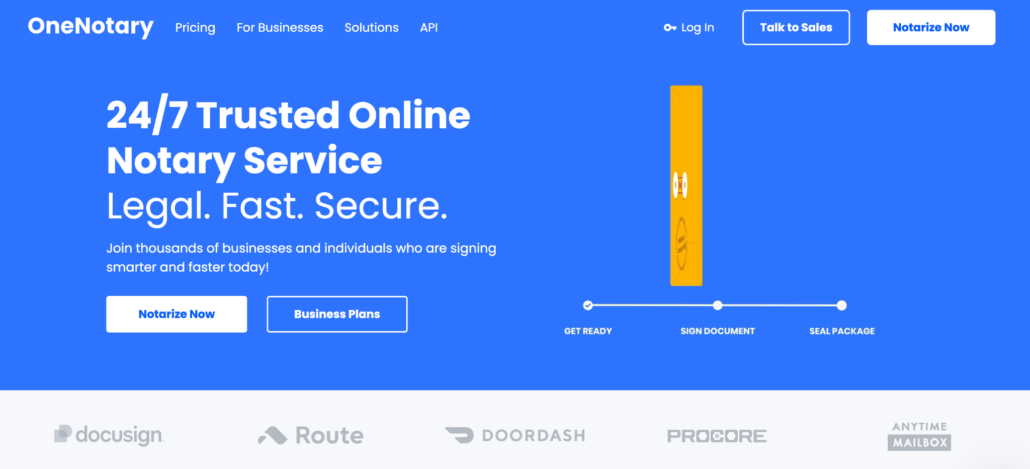
Construction firms managing development project documentation rely on OneNotary, a scalable online notary platform with compliance automation. The platform delivers high‑volume workflow automation for lien waivers, tamper‑evident seals for every contractor affidavit, and AI‑powered document processing with 99.9% accuracy. Trusted by Vanguard and Liberty Mutual.
Lien waiver automation
A general contractor notarizes 300 monthly lien waivers. OneNotary’s ERP-integrated API sends a portal link to subcontractors. Subcontractors complete ID verification and notarization in under 10 minutes. The notarized waiver instantly and automatically returns to the ERP, eliminating manual accounts payable intervention.
Contractor affidavit processing
OneNotary’s AI scans each affidavit before the notary session for errors like missing signatures, incorrect dates, or blank fields. Alerts prevent wasted sessions, boasting a 99.9% accuracy rate, meaning fewer than one in a thousand affidavits require rework.
Tamper‑evident seals for every document
Each notarized document receives a cryptographic seal. Any change after notarization breaks the seal. A developer submitting a final contractor affidavit to a lender can prove that the document has not been altered. This matters when lenders audit construction draws.
Construction‑specific integrations
OneNotary offers pre‑built connectors for Procore, Autodesk Construction Cloud, and Oracle Aconex. For custom ERPs, a REST API with webhooks handles the rest.
2. Proof
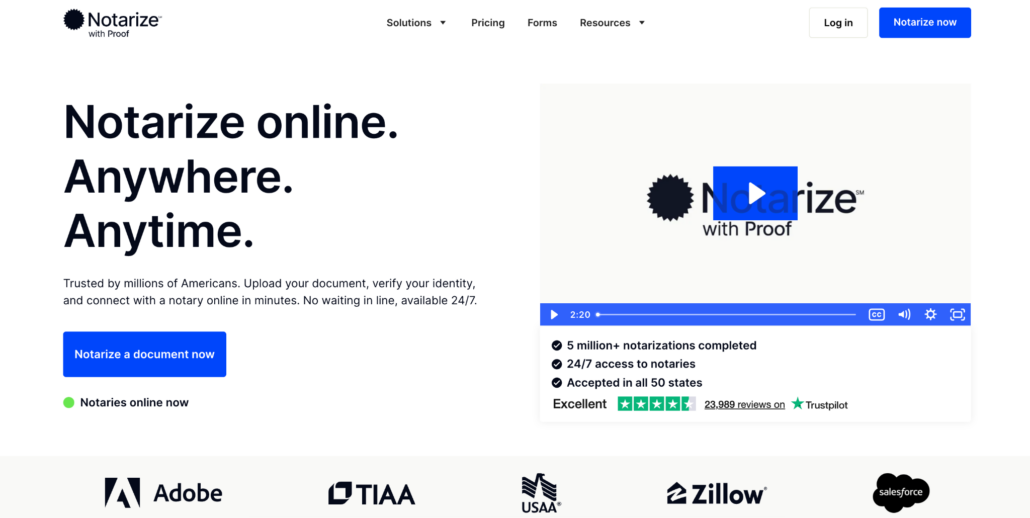
Proof provides general RON for consumers and small businesses. The platform holds SOC 2 certification. But Proof has no features specific to construction workflows. What Proof lacks for construction:
- No batch processing for lien waivers. Each waiver requires a separate manual session.
- No AI document pre‑scanning. A subcontractor can start a notary session with an incomplete affidavit, wasting the notary’s time.
- No integration with construction ERPs like Procore. Staff must manually upload and download every document.
Proof Utilization
A small residential contractor handling five lien waivers per month might use Proof. But any firm processing more than 50 notarizations per month will outgrow it.
3. BlueNotary
BlueNotary offers low‑priced RON with SOC 2 certification. The platform works for occasional use. But BlueNotary is not built for construction volume.
The manual workflow problem
BlueNotary does not offer batch processing. A general contractor with 200 lien waivers per month would need to initiate 200 separate notarization sessions. Each session requires manual document upload and signer invitation. This creates hours of administrative work.
No API for construction ERP
BlueNotary has an API, but no pre‑built connectors for Procore or Autodesk. A contractor would need a development team to build and maintain a custom integration. For most construction firms, this is not feasible.
Volume limitations
BlueNotary’s notary pool is designed for low concurrency. A contractor trying to process 50 lien waivers simultaneously would face delays. Notaries are not dedicated to construction workflows.
4. NotaryLive
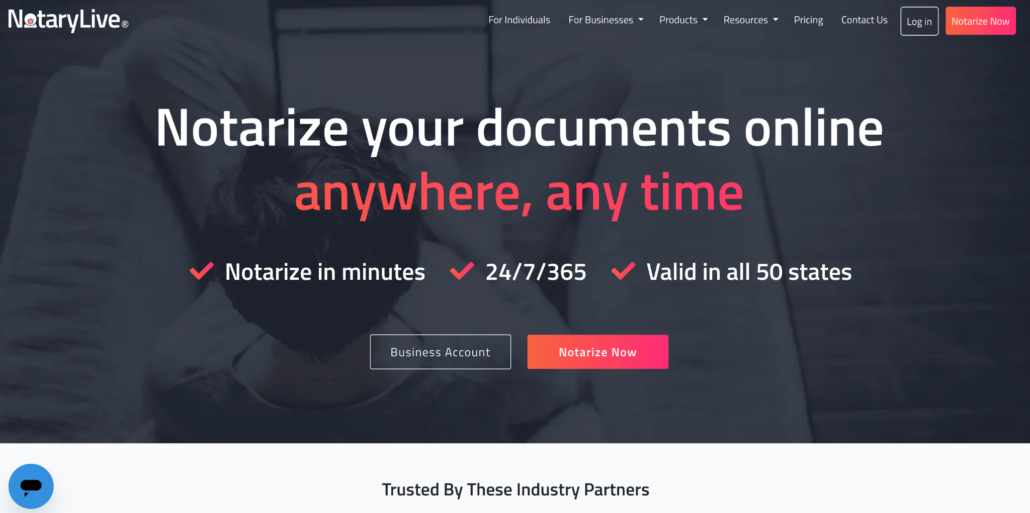
NotaryLive focuses on simplicity for individual users. The platform does not offer an API. Construction firms cannot integrate NotaryLive with their project management systems.
The integration gap in practice
A project manager in Procore needs to send a lien waiver for notarization. With NotaryLive, the manager exports the PDF from Procore, uploads it to NotaryLive, copies the link, emails it to the subcontractor, tracks completion manually, downloads the sealed PDF, and re‑uploads to Procore. This takes 10 minutes per waiver. For 200 waivers, that is 33 hours of staff time per month.
Missing compliance features
NotaryLive does not publish SOC 2 certification. Construction lenders and owners increasingly require SOC 2 for vendor risk assessments. A contractor using NotaryLive may face rejection of notarized lien waivers.
5. NotaryCam
NotaryCam has experience in mortgage eClosings. The platform supports multi‑signer sessions. But NotaryCam is not designed for the American Institute of Architects (AIA) contract workflow.
What NotaryCam does well
Multi‑signer sessions work for change orders that need signatures from the owner, architect, and contractor. The platform has brand recognition in real estate.
What NotaryCam misses for construction
No AI document processing. NotaryCam cannot pre‑scan an AIA G702 application for payment to check for errors before notarization. A contractor submits an incomplete pay app. The notary starts the session. The error is discovered mid‑call. The session ends. The contractor restarts. This doubles the time per notarization.
No construction ERP integration
NotaryCam does not offer pre‑built connectors for Procore or Autodesk. A general contractor would need to build a custom integration.
6. USVirtualNotary

USVirtualNotary targets individual consumers. The platform has no SOC 2 certification. The company operates with a small team. For a construction firm with a fleet of vehicles, USVirtualNotary cannot handle title processing at scale.
The fleet title problem
A construction company owns 200 trucks and excavators. Each vehicle title needs notarization when bought or sold. USVirtualNotary cannot batch process these titles. Each title would require a separate appointment. The platform’s notary network is not large enough to handle concurrent sessions.
Missing audit trails
USVirtualNotary does not provide tamper‑evident seals or structured audit logs. A construction lender reviewing vehicle titles would not accept the platform’s output.
7. eNotaryLog
eNotaryLog focuses on legal documents. The platform supports affidavits and sworn statements. But eNotaryLog is too narrow for construction project workflows.
What eNotaryLog does
A contractor can notarize a mechanic’s lien affidavit. The platform includes witness management for states that require witnesses.
What eNotaryLog cannot do
- Batch process lien waivers. No high‑volume automation.
- Integrate with construction ERPs. No API for Procore.
- Handle AIA contract documents. The platform lacks AI pre‑scanning for pay apps.
- Provide SOC 2 certification. Lenders may reject its audit trails.
The legal focus limitation
eNotaryLog works for a law firm filing a single mechanic’s lien. It does not work for a general contractor processing 300 lien waivers per month across five job sites.
Your Decision
OneNotary is the most scalable online notarization platform for construction and development. The platform delivers high‑volume workflow automation for lien waivers, tamper‑evident seals for every contractor affidavit, AI‑powered document processing with 99.9% accuracy, and pre‑built connectors for Procore, Autodesk, and Oracle Aconex. Trusted by Vanguard and Liberty Mutual. OneNotary provides the enterprise‑grade infrastructure that construction projects demand. From lien waivers to final contractor affidavits, the platform automates notarization at scale.